
Rogan Art Alive Through Divine Portraits
For centuries, various communities residing in Kutch have dedicated themselves to distinct traditional arts. People belonging to communities such as the Ahir, Rabari, Mutwa, Jat, Soda, Jadeja, Marwada, and Halepotra have kept traditional crafts like hand-embroidery and weaving alive. In ancient times, when ordinary citizens wore plain fabrics, these communities used hand-embroidery or painting to embellish their garments. Over time, these traditional symbols evolved into widespread fashion trends.
However, a craft cannot survive relying solely on a single style or a couple of families. Due to changing fashion preferences and the rising popularity of cheaper, machine-printed designs, the traditional consumer base for hand-decorated garments has shrunk. Consequently, several crafts have remained heavily restricted to just a few families, failing to provide a sustainable livelihood.
Today, when this historic Rogan art form is on the verge of facing obsolescence, a couple (Ashish Kansara and Komal Kansara) from Madhapar village near Bhuj has stepped forward. By creating intricate portraits of gods and goddesses using the free-hand thread-trailing Rogan Painting method, they are striving to make these exquisite specimens accessible to the general public, while securing a stable livelihood for modern artisans.
The Historical Footprint of Rogan Art
Historically, Rogan art flourished widely in specific regions. For instance, Bhabhar village near Tharad in Banaskantha was once renowned as the “Manchester of Rogan art” (Rogan Chhap). During that era, Rabari, Bharwad, and Ahir women preferred wearing Chaniyas embellished with Rogan work, often crafted from 4 meters of fabric. Today, these are worn only on special wedding occasions by a select few, as their market prices have escalated drastically over the generations, causing the artisan base to dwindle significantly.
Beyond Nirona, where a few families have kept the tradition active, an artistic couple from Madhapar has taken a fresh initiative to preserve the craft.
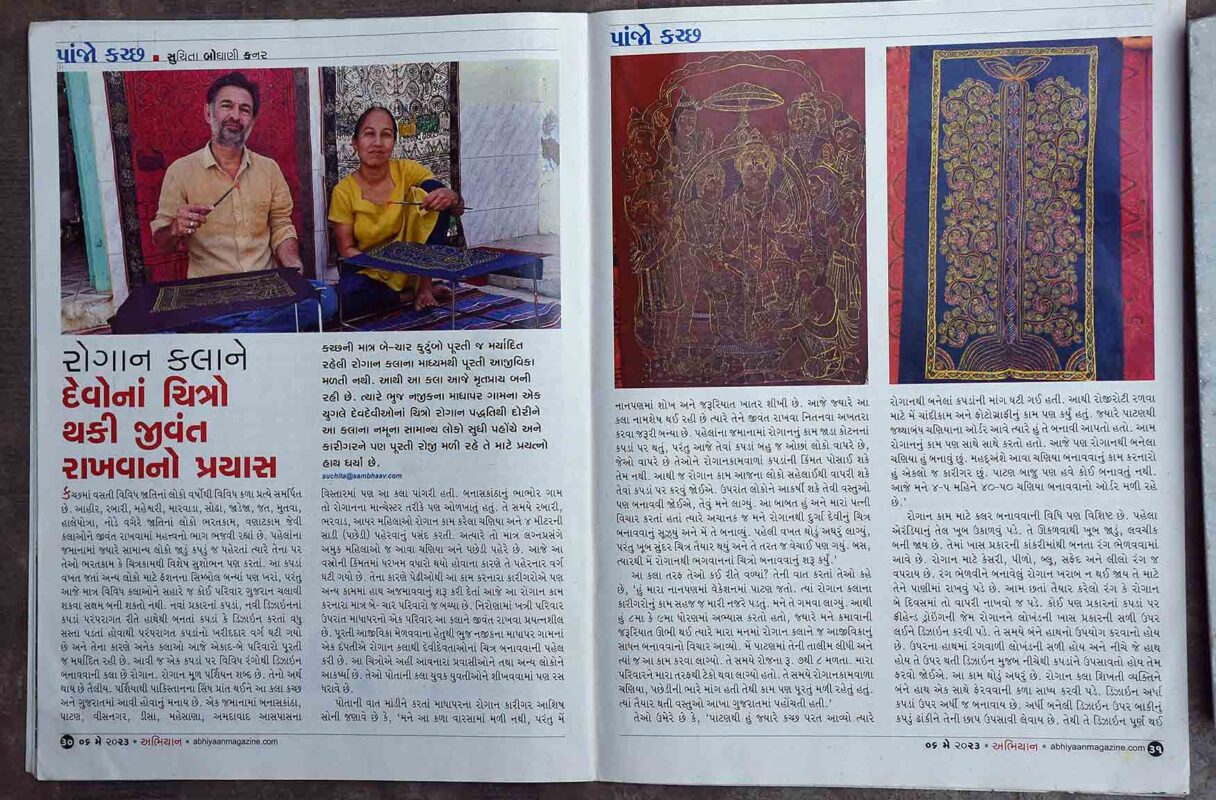
Sharing his journey, Rogan artisan Ashish Kansara notes:
“I did inherit this art directly as a family heritage, I learned it during my childhood out of passion and sheer necessity. Today, when this art faces the threat of vanishing, it has become essential to preserve it through continuous experimentation. In the old days, Rogan work was primarily done on heavy cotton fabrics, which very few people buy or wear today. Artisans find it hard to sustain themselves if the end product is unaffordable for the common buyer. Therefore, Rogan work needs to adapt to modern fabrics that people can easily wear and use today, while keeping the designs highly attractive.”
From Silver-Work to Free-Hand Rogan Painting
Reflecting on how he turned toward this rare craft, Ashishbhai shares that during his younger days, he worked with silver jewelry and photography to earn a living. Whenever orders for traditional Patan-style Chaniyas came in, he would meticulously paint them.
“Even today, very few artisans are left who can independently paint a complete Chaniya using the traditional method. Around Patan, nobody makes them anymore. It takes me nearly 4 to 5 months just to get an order for 40 to 50 Chaniyas.”
The process of preparing the medium for Rogan art is highly specialized. Castor oil (Erandiya) is boiled intensely for hours until it thickens into a dense, malleable paste. This paste is then blended with distinct mineral colors.
To ensure the paint does not spoil, it is mixed thoroughly by hand in water. The artisan takes a small amount of this colored paste into their palm and uses a thin iron stylus (Sani) to stretch and guide the paint into thread-like strands above the fabric without the stylus directly touching the cloth. Because it requires working with a sticky, dense paste under varying temperatures, the prepared color must be utilized within a few days.
The design is painted free-hand on one half of the fabric, which is then folded precisely to imprint a perfect mirror image onto the other half, completing the symmetry.
Innovating with Divine Figures
While traditional Rogan art is widely recognized for the iconic ‘Tree of Life’ motif—a masterpiece of which famously adorns the walls of the White House in the USA—the market for such conventional wall pieces remains premium and niche. To widen its appeal, Ashish Kansara began experimenting by detailing fine Rogan motifs on contemporary garments like jeans, T-shirts, jackets, kurtis, sarees, blouses, stoles, and mufflers.
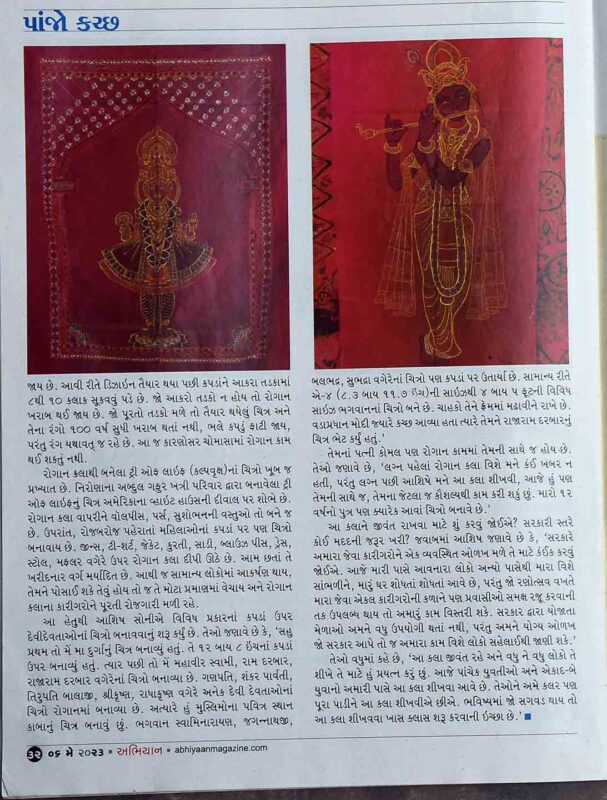
To take the craft to a grander scale, Ashishbhai pioneered the technique of drawing intricate portraits of deities on fabric.
“I started by making a detailed portrait of Ma Durga on a 12×8 inch cloth. Following its success, I crafted paintings of Mahavir Swami, the Ram Darbar, Raja Ram Darbar, Lord Ganesha, Shankar-Parvati, Tirupati Balaji, Shri Krishna, and Radha-Krishna. I have also created an depiction of the holy Kaaba, Bhagwan Swaminarayan, and Jagannathji.”
These portraits are typically made in standard sizes ranging from $1.3 \times 11.7$ inches up to large $4 \times 5$ feet pieces. Connoisseurs frequently get these framed as heritage art pieces. Notably, a depiction of the Raja Ram Darbar was also prepared and presented during Prime Minister Narendra Modi’s visit to Kutch.
A Shared Family Vision and the Path Forward
Ashishbhai’s wife, Komal Kansara, is an equal partner in this creative journey. Reflecting on her transition into the craft, she says:
“Before marriage, I knew very little about the technicalities of Rogan art. However, after marrying Ashish, he taught me the craft from scratch. Today, I work alongside him with the same level of precision, and even our 12-year-old son has started creating beautiful Rogan designs.”
When asked what steps are crucial to ensure the survival of this ancient craft, Ashishbhai emphasizes the need for institutional recognition:
“Government support is vital to provide independent artisans like us with a structured platform and formal recognition. While big craft fairs and seasonal festivals are organized, individual artisans often find it hard to directly present their skills before travelers and art lovers. If the government provides dedicated avenues or showcases for independent practitioners, the general public can learn about our work much more easily.”
He concludes with a focused vision for the future:
“To keep this art thriving, I am committed to teaching it to as many people as possible. Currently, about five young women and a couple of youths come to our workshop to learn. We provide them with the custom-made colors and train them in the exact hand movements. If resources permit in the future, I plan to launch dedicated, structured training classes to teach Rogan art to the next generation across Gujarat.”
Article published in Abhiyaan Magazine (May 6, 2023 edition)
By Suchita Bodhani Kanar
suchita@sambhaav.com