
History of Rogan Art
Kutch Rogan Craft is one of the world’s most breathtaking textile traditions. For generations, this intricate art form—defined by its brilliant use of boiled castor oil paste mixed with vibrant mineral pigments—has captured the imagination of art connoisseurs globally. When discussing the preservation of this 1,550-year-old technique, the conversation naturally highlights the geographic hubs keeping the craft alive. While many associate the craft’s recent revival with the village of Madhapar, the contemporary landscape of Rogan art spans across key centers in Kutch, including thriving hubs like Rogan art Nirona.
Understanding the relationship between these artistic centers is essential to appreciating the full scope of Kutch Rogan Craft today.
Expanding the Canvas: The Growth of Rogan Art in Madhapar
Today, the evolution of Kutch Rogan Craft includes a powerful renaissance in villages like Madhapar, located near Bhuj.
In Madhapar, the practice has transitioned from a strictly guarded family secret into an inclusive, community-driven movement. Master artisans in Madhapar have expanded the craft by establishing dedicated trusts and training programs. By opening up the learning process to new apprentices—particularly empowering local women artisans—Madhapar has successfully transformed Rogan art from an endangered legacy into a sustainable, modern livelihood.
This expansion ensures that the 1,550-year-old technique, which traces its ancient roots along historical trade routes, continues to adapt, innovate, and thrive in the 21st century.
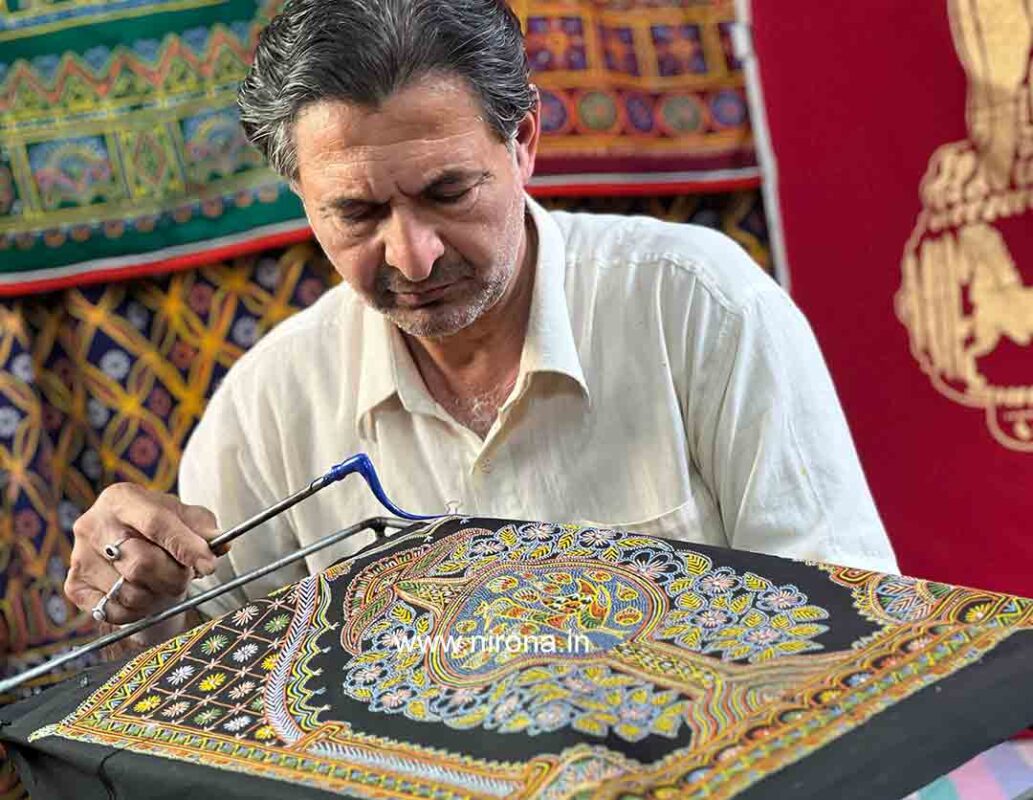
The Historical Roots of Rogan Art in Nirona
For decades, the quiet village of Nirona in northern Kutch has been widely recognized as a crucial sanctuary for Rogan painting. When industrialization and cheap, machine-made textiles forced many traditional artisans to abandon their heritage, Nirona became famous as a resilient stronghold where the delicate practice survived.
In Nirona, the craft became a focal point for tourism and cultural documentation. Visitors from around the world travel to the village to witness artisans using a blunt metal stylus to guide thread-like strands of cast-iron paste onto fabric, creating perfectly symmetrical, freehand geometric patterns. This deep historical association is why search terms like “Rogan art Nirona“ remain highly prominent for people researching the origins of the craft.
Preserving a Living Heritage
Whether a piece originates from the historic lanes of Nirona or the bustling workshops of Madhapar, true Rogan art requires the exact same grueling, masterful process. The castor oil must still be boiled for over 12 hours to create the perfect Rogan paste, and the artist must still possess the incredible spatial awareness required to paint without any pre-drawn sketches.
By recognizing the contributions of both Nirona and Madhapar, art enthusiasts get a complete, authentic picture of how this magnificent Kshatriya community art form continues to colour the world.