
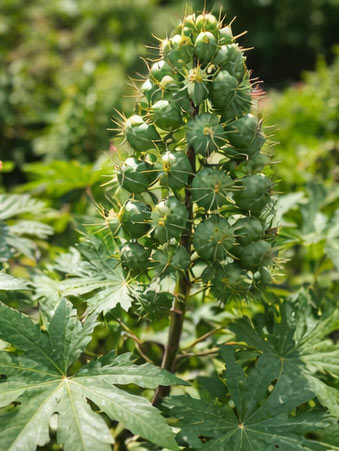
Castor oil comes from the seeds of the castor plant (Ricinus communis), a crop widely known for its toxic nature. In rural India, animals instinctively avoid eating castor leaves or seeds. Farmers are aware that castor cake, if not detoxified, can be fatal to cattle. The reason is simple: castor seeds contain ricin, one of the most poisonous naturally occurring substances. Yet, paradoxically, this same plant has played a crucial role in one of India’s most extraordinary traditional art forms—Rogan art.
This contrast between poison and creativity is not accidental. It reflects the deep material knowledge embedded in Indian artisanal traditions, where dangerous, raw, or unstable substances were carefully transformed through experience, technique, and discipline into tools of cultural expression. Master Rogan painting artist Ashish Kansara has stated that castor oil is an exceptionally strong and durable medium for oil painting, capable of lasting for centuries without fading. He points to the oil paintings found in the Bamiyan region of Afghanistan—dated to around 1550 years old—as evidence of early oil painting traditions that relied on castor oil or similar plant-based oils.
Understanding Castor Oil as a “Poison Crop”
In agrarian knowledge systems, castor is classified as a non-edible, non-fodder crop. Grazing animals avoid it, and traditional communities clearly distinguished it from food or medicinal plants. The toxicity lies primarily in the raw seed. However, when castor oil is extracted through prolonged boiling and purification, the lethal components are neutralized, leaving behind a thick, viscous oil with unique physical properties.
This distinction—between raw poison and processed material—is critical. Indian crafts never treated materials casually. The transformation of castor seed into usable oil required time, controlled heat, and observation. Only after repeated boiling and aging does castor oil become stable enough for artistic use.
Why Rogan Artists Chose Castor Oil
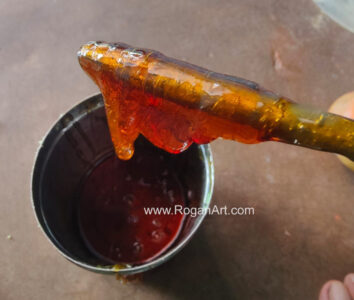
Rogan art, traditionally practiced in Gujarat and earlier regions of the Indian subcontinent, depends entirely on castor oil as its base medium. No other oil behaves in the same way. When cooked slowly for many hours, castor oil thickens into a jelly-like substance. This substance can hold pigment, stretch into fine threads, and remain suspended on fabric without bleeding.
Unlike vegetable oils used for cooking, castor oil does not dry quickly. It allows the artist to draw lines in the air, placing the paint directly onto cloth without a brush. This property is essential to Rogan painting, where motifs are created using a metal or wooden rod, not conventional tools.
Thus, a crop rejected by animals and unsuitable for food becomes indispensable to artistic creation.
From Danger to Discipline
The use of a toxic crop demanded strict discipline. Rogan artists historically prepared their own oil, often within the family, passing down precise methods orally. Incorrect preparation could ruin the oil or make it unusable. This knowledge was not written in manuals but preserved through apprenticeship and observation.
The process itself reflects an advanced understanding of chemistry without formal scientific language. Heat alters molecular structure. Time stabilizes viscosity. Natural pigments bind only at a certain thickness. These principles were learned empirically, generation after generation.
This is why Rogan art cannot be industrialized easily. Synthetic substitutes fail to replicate the behaviour of castor oil prepared through traditional methods.
Symbolism Beyond Material
There is also a deeper symbolic layer. Rogan art often features motifs like the Tree of Life, flowers, animals, and cosmic symmetry—images associated with fertility, continuity, and balance. That such imagery emerges from a medium derived from a poisonous plant is significant. It echoes an ancient Indian philosophical idea: transformation, not rejection, is the path to creation.
Poison is not denied; it is mastered.
This worldview is visible across Indian traditions, from Ayurveda to metallurgy, where toxic substances were processed into medicine or alloys. Rogan art stands firmly within this intellectual lineage.
Castor Oil and Indian Oil Painting Traditions
Long before European oil painting traditions emerged, Indian artists were experimenting with oil-based media. The use of castor oil in Rogan painting demonstrates that oil painting in India was not borrowed but developed independently, using locally available materials.
The thick oil medium, combined with mineral and natural pigments, creates paintings that can last for decades without cracking. Historic Rogan works show remarkable durability, further proving the sophistication of the material science involved.
Living Tradition, Fragile Knowledge
Today, very few artists like Ashish Kansara still prepare Rogan oil traditionally. Modern pressures, lack of documentation, and the spread of simplified narratives have pushed this knowledge to the margins. Castor oil is often reduced to a footnote, rather than recognized as the foundation of the entire art form.
Understanding Rogan art without understanding castor oil is impossible. The crop’s toxicity, the careful purification, and the artistic transformation are all part of one continuous knowledge system.
Conclusion
Castor oil is a reminder that creativity does not always come from safe or comfortable sources. In Rogan art, a poisonous crop avoided by animals becomes the soul of a living artistic tradition. This transformation is not accidental—it is the result of centuries of observation, discipline, and inherited wisdom.
Rogan art is not just painting. It is material intelligence made visible.